

• 30% would delay retirement and 17% would re-enter the workforce to afford sight-saving treatment
• Over a quarter of working Australians believe they would go into debt (27%), while 28% of retirees believe they would go without treatment.
New research commissioned by Macular Disease Foundation Australia reveals the sacrifices Australians would make to save their sight, including delaying retirement, returning to work or reducing their superannuation contributions.
The findings, released as part of Macula Month 2026, show three in ten Australians would delay their retirement to afford sight-saving treatment if diagnosed with macular disease.
Approximately one in seven Australians over the age of 50 have some evidence of age-related macular degeneration (AMD).
Macular Disease Foundation CEO Dr Kathy Chapman said the YouGov survey of more than 1,000 Australians aged 50-70 highlights a confronting reality, with many people understanding the critical need for treatment but unable to afford it.
“No one should have to sacrifice a dignified retirement to save their vision. It’s an unacceptable choice that should concern all Australians,” Dr Chapman said.
Michael from Sydney has AMD in both eyes and is still working at 81 to afford sight-saving treatment.
“When I stop working, the injections will stop,” Michael said. “Certainly in one eye, and most likely in both. From there it’s just a waiting game until I go blind. That’s the fear I live with every day.”
The findings also expose a stark reality for low-income households and pension card holders, the most financially vulnerable Australians.
“There is simply no slack in household budgets for pensioners,” Dr Chapman said. “With the rising cost of essentials like housing, energy and groceries, many cannot see any viable way to afford ongoing treatment.
”Treatment for AMD is frequent (typically every four to 16 weeks) and usually lifelong. Cost is one of the main reasons people stop their eye injections, with about 50% of patients discontinuing treatment within five years.1
Eye injections are primarily delivered in private ophthalmology clinics in Australia, with only around 28 percent of them offering bulk billing.2 This means more than 72,000 people3 having eye injections have no choice but to pay expensive out-of-pocket costs to receive their treatment to save their sight. Sadly, that’s a price many Australians cannot afford.
For patients like Michael, the consequences of stopping treatment are frightening.
“The thought of losing my vision and driver’s licence is terrifying,” Michael said. “It wouldn’t just affect my independence. It would rob me of my ability to care for my wife and drive her to medical appointments.”
To address this eye care crisis, Macular Disease Foundation is calling on the Federal Government to introduce a Neovascular AMD Treatment Incentive Program. The aim of the program is to encourage ophthalmologists to bulk bill pension card holders having eye injections for neovascular AMD, and support those most at risk of stopping treatment due to burden of cost.
In 2010, the total annual economic cost of vision loss in Australia was estimated to be $16.6 billion or $29,000 per person with vision loss aged over 40.4 The total annual economic cost of vision loss associated with AMD specifically was estimated at $5.15 billion, of which the direct cost was $748.4 million ($6,982 per person)5. These costs are likely to be an under-estimate given they are from 2010 and have not been adjusted for inflation.
By targeting the most financially vulnerable people who need sight-saving treatment and encouraging more bulk billing, Macular Disease Foundation believes a Neovascular AMD Treatment Incentive Program would cost the government an estimated $40 million a year and ultimately save government $580 million annually.
Posted: 1 May 2026
More information
About Macular Disease Foundation Australia
Macular Disease Foundation Australia is the independent national peak body fighting for the sight of the macular disease community. Our purpose is to reduce the impact of macular disease.
We work with the community and the health system to promote early detection, reduce progressive vision loss and to save sight. We provide a range of free, tailored resources and support services to help people live optimally with macular disease. Our advocacy work amplifies the voice of our community to influence and collaborate for positive outcomes. We invest in vital research, working towards better management, treatments, and cures. Our work is supported by the generosity of the Australian community.
About macular disease
Macular disease covers a range of conditions that affect the central retina (the macula) at the back of the eye. People with macular disease progressively lose their detailed central vision, and the ability to recognise faces, read, drive and undertake many aspects of daily life. The most common conditions are age-related macular degeneration (AMD) and diabetic retinopathy, including diabetic macular oedema.
One in seven (approximately 1.5 million) Australians over the age of 50 have some evidence of AMD.
Diabetes-related eye disease affects between 25% to 35%6 of the 1.5 million people7 with diagnosed diabetes – and is the leading cause of preventable blindness among the working-age population.
References
1 Pharmaceutical Benefits Advisory Committee – Drug Utilisation Sub Committee (2018). Ranibizumab and Aflibercept: Analysis of Use for AMD, DMO, BRVO and CRVO. Accessed at https://www.pbs.gov.au/pbs/industry/listing/participants/public-release-docs/201805/ranibizumab_and_aflibercept__analysis_of_use_for_amd%2C_dmo%2C_b
2 Macular Disease Foundation Australia, Royal Australian and New Zealand College of Ophthalmologists and PwC Australia. (2019). Impact of IVI rebate changes.
3 Services Australia data on Medicare services delivered between 01/01/2022 to 31/12/2023 and processed up to 17 February 2025.
4 Deloitte Access Economics and Vision 2020 Australia (2010). Clear Focus – The Economic Impact of Vision Loss in Australia in 2009. Accessed at https://www.vision2020australia.org.au/resources/clear-focus-the-economic-impact-of-vision-loss-in-australia-in-2009/.
5 Macular Disease Foundation Australia. 2011. Eyes on the future – a clear outlook on age-related macular degeneration. Accessed at: www.mdfoundation.com.au/resources/eyes-on-the-future/.
6 S. Keel, J. Xie, J. Foreman, P. van Wijngaarden, H.R. Taylor, M. Dirani. The prevalence of diabetic retinopathy in Australian adults with self-reported diabetes: the National Eye Health Survey. Ophthalmology, 124 (7) (2017), pp. 977-984.
7 Ref: Diabetes Australia website. Diabetes Australia | Support for people living with diabetes
MEDIA CONTACTS:
Natasha Rontziokos | Buzz Group | E: [email protected] | M: +61 421 272 390
Caroline Parsons | Buzz Group | E: [email protected] | M: +61 472 505 663
Jason Hemens | Macular Disease Foundation Australia | E: [email protected] | M: +61 0400507451
The information provided in this release is provided by Macular Disease Foundation Australia located at Mezzanine Level, 383 Kent Street Sydney NSW 2000.


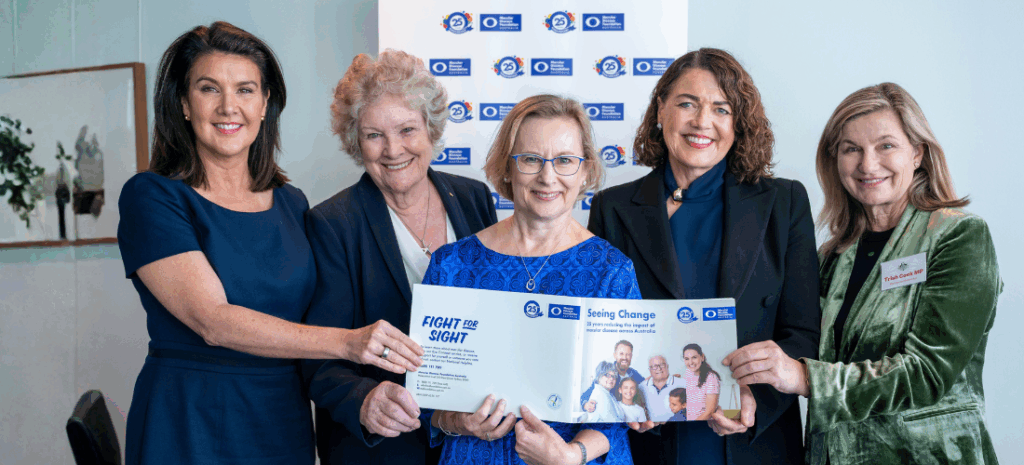
Celebrating 25 years of impact at Parliament House
Macular Disease Foundation Australia has marked a significant milestone at Parliament House, celebrating 25 years of dedicated work to protect the sight of Australians living with macular disease.